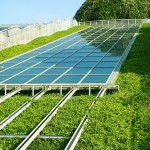
I have really come to appreciate the way Ontario’s feed-in tariff (FIT) for projects 10 kW and less, the microFIT, allows the little guy to get into the energy game. Home solar installations are hardly new, but until recently, they have traditionally been cost-prohibitive and inefficient. Today, however, the possibilities are staggering, and in Ontario at least, these possibilities start with the microFIT.
Like the FIT for larger projects, the microFIT pays producers of renewable energy above-market rates for green power fed into the grid, locked into a twenty-year contract. In fact, small-scale rooftop photovoltaic installations receive the highest prices of the whole initiative, 80.2 cents/kW-hour. This has inspired some to install rooftop and ground-mounted systems on their houses and properties, and it has truly opened the door for energy independence at the individual level, not to mention the new opportunities for businesses and solar training courses. Welcome to the world of decentralized energy.
We are watching evolution in real-time. Evolution is, by definition, a struggle, and since the inception of the FIT and microFIT, the programs have caused or suffered from pricing fluctuations, hikes in electricity rates, and international trade issues. Seen from a macro level, however, the green energy revolution isn’t doing so poorly. Uninterrupted electricity supply to every home is barely over a century old - other systems, like capitalism and science, both of which are considerably older, continually have to work out new kinks and inconsistencies.
Photovoltaic Courses, Green Careers Signs of a Bright Future
A century ago, only a small fraction of homes in Canada had access to electricity - now nearly all homes do. Today, only a fraction of homes produce energy on-site - it is not far-fetched to think that in decades to come, the increasing efficiency and versatility of solar energy systems, and their decreasing prices, will allow everyone to contribute to a communal grid. Technologies like Cyrium’s CPV cups and Sustainable Energy Technologies’ SUNERGY inverters are crushing the problems of efficiency and versatility, and services such as those offered by Atlantic Wind and Solar and Rooftop Solar Developments, among other companies and initiatives, remove the burden of start-up costs by fronting the money for a slice of the twenty-year pie.
New green career opportunities are also made sweeter by decentralization. While it would be unrealistic at this point to compare solar installers to, say, oil rig workers in terms of income or demand, solar installations are typically located where they are needed most - i.e. close to where people live. Rather than leaving families behind to move where the work is, the new generation of energy workers enjoys greater flexibility. Entrepreneurial potential is also greater, as the solar energy industry is characterized by more small-scale companies than a handful of huge ones. Photovoltaic courses such as those offered by Ontario Solar Academy and a bit of research into how to start a small business may be all that stands between you and a new career as the owner of your own company, bringing green energy to neighbourhoods across the province.
A small but classic example of the way that today’s solar industry empowers citizens in Ontario is the Apollo Project at Bear Creek Secondary School in Barrie, where students prepare for careers, both conventional and green alike. In just a short time, the project has generated 2,300 kW of solar power and $2,000 in revenue for the school from its rooftop installation, all the while educating students on the technical aspects and possibilities of solar. Stories like this pepper the Web. This is just one example from one community in one sparsely populated country of the world. Think of the possibilities. That’s solar power.