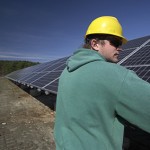
 October 1 marks the one-year anniversary of Ontario’s aggressive feed-in tariff (FIT) program, designed to accelerate renewable energy adoption across the province. Under the FIT program, which covers both large-scale and smaller scale renewable energy projects, the Ontario government prioritizes buying power from clean sources at a premium price. The program also requires that a portion of all labour and solar equipment come from within Ontario, encouraging both local production and provincial solar installation and training programs.
Solar and other alternative energy markets in Ontario have grown rapidly since the implementation of the FIT program. Over the past year, about 23,000 applications have been submitted to the Ontario Power Authority (OPA). Installation of small-scale rooftop solar power systems (proposed mainly by homeowners and farmers) compose more than 85% of the submissions.
While small-scale solar installations dominate the list of FIT applications, they make up less than 1% of the power (in megawatts) applied for during the past year. Large-scale solar and wind projects represent the overwhelming majority of the 15,000 megawatts already submitted.
Transmission Restraints Slow Solar Installation in Ontario
During the first year of Ontario’s FIT program, the OPA offered contracts on projects worth just over 2,500 megawatts. The majority of these contracts, however, will not be completed in the near future. Many of the large-scale projects await approval because the transmission system in Ontario lacks the necessary infrastructure to distribute this new power. As a result, most of the approved contracts are for small-scale installations, which have allowed solar training and installation programs to thrive within the province.
Detractors of Ontario’s Solar Market
The FIT program’s success in terms of applications and upcoming contract approvals is not under question. Critics of the program, however, often point to this very success as a weakness within the system. Power prices in Ontario have been steadily increasing, and the sudden rise in green power projects is often cited as the cause. While the price of power in Ontario has indeed increased, deploying new renewable energy projects is typically cheaper than developing traditional alternatives like nuclear plants and natural gas facilities.
Solar energy produced from small-scale projects like rooftop installations costs 80 cents per kilowatt-hour. This is considerably more than power produced from wind or nuclear facilities (less than 15 cents per kilowatt-hour), but solar power’s overall contribution to Ontario’s energy portfolio accounts for less than 1%, suggesting that pinning the increasing costs of energy Ontario on green power is inaccurate and misleading.