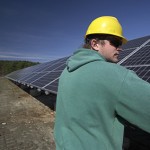
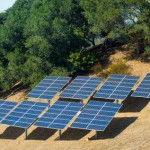
 Renewable energy installations are changing the landscape. Of course, they change the physical landscape, with solar farms spread out along farmers’ fields and wind turbines lining coasts, but they have also begun to change the social and economic landscapes as well. Nowhere in North America can you see this more prominently than in Ontario.
Ontario instituted its Green Energy and Green Economy Act (Green Energy Act) in May of 2009, which allowed the province to present its feed-in tariff (FIT) program later the same year. The FIT pays high rates to owners of green energy installations, such as solar and wind farms, that tie their projects into the province’s electrical grid. Its companion program, the microFIT, pays even higher prices, depending on the type of installation, to projects that generate 10 kW and less. Small rooftop solar tie-ins earn the most, 80.2 cents/kW-hour. Since it instituted the Act and the program, the Ontario Power Authority (OPA) has receivedthousands of applications.
According to the latest forecast from the Independent Electricity System Operator (IESO), Ontario will add about 2400 MW of green electricity to its energy supply between the end of 2010 and early 2012. It is clear that the province will have no shortage of jobs for workers with PV installation training, particularly since in order to participate in the FIT and microFIT programs, renewable energy projects must source up to 50% of their labour from within the province. Next year, that number will rise to 60%.
Communities Draw Green Business, Installations, Workers
These are encouraging examples of how green energy is changing the physical and economic landscapes, but it now changes communities, too. Cities, towns, and First Nation communities across a large segment of south-western Ontario have begun to gel together as a group to support renewables, under what the Brantford-Brant Chamber of Commerce calls the “Green Energy Hub.” The purpose of the name is to act as a beacon, attracting manufacturers, renewable energy installations, and PV-trained workers to an area that reaches out in all directions, from the shores of Lake Erie to Paris and Port Rowan to Dunnville.
The social landscape is also changing at the micro level, thanks to green energy. This is kind of a chicken vs. egg scenario because a change in attitudes triggered the FIT, and now the program, in turn, is helping to change attitudes. The shift starts at young ages, too. Universities, high schools, and even elementary schools in the province have all taken it upon themselves to teach kids and young adults about the importance of green energy. Moreover, by providing some basic training on PV and other types of installations, schools are empowering their students to become more involved.
It is interesting to speculate about what the world will look like, say, in twenty years when today’s current FIT contracts begin to expire. Will it glisten with solar farms, or will the leaps-and-bounds advancements in technology eventually make the PV and other green energy installations on roofs and in fields invisible, where the only sign of them is the clean air we will breathe? Time will tell.